A harbinger of hope or the culmination of an extra-ordinary journey.
A big night or a bigger dawn ?
It is yet to be seen if the political will can be renewed or if the potential for participatory democracy been really knocked upon.
Nevertheless, what an inspirational story it has been of personal triumph against all odds.
The "last hurrah" or can there ever be one ?
Showing posts with label Leadership. Show all posts
Showing posts with label Leadership. Show all posts
Tuesday, November 04, 2008

Wednesday, September 27, 2006
Bill Drayton and Ashoka: Defining Social Enterpreneurship
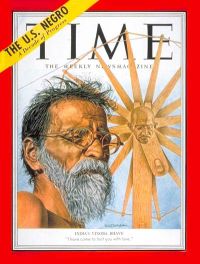
Vinoba’s stupendous Bhoodaan effort was drawing attention in the west. In the United States, major articles on Vinoba appeared in the New York Times, the New Yorker and on the cover of Time as well. If it was Gandhi who influenced Vinoba as a 20 year old, little did anyone know that Vinoba was going to inspire another 20 year old, albeit, on the other side of the world.
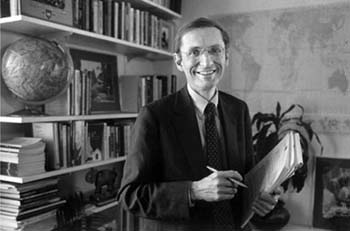
In 1963, Bill Drayton, a 20 year old student from Harvard was spending his summer break at Munich, Germany when he first heard of Vinoba's Bhoodaan. He was so inspired by Vinoba's simple idea that he decided to drive his red and white Volkswagen van from Munich to India to join him. Bill joined Vinoba on his foot march and witnessed the power of a simple idea by a single person to bring out a massive social change. This experience left a mark on him.
Back to Harvard, Bill started an inter-disciplinary forum called "Ashoka Table" where students could interact with officials from the government and the industry. It was here that he nurtured a greater vision. Following his studies at Harvard, Yale and Oxford and working at McKinsey and U.S. Environmental Protection Agency, in 1980 Bill formed "Ashoka", his dream venture to create real change worldwide. Ashoka was named after the visionary and benovolent Indian emperor of 3rd century BC.
Bill Drayton's idea was simple, yet pathbreaking. He knew that throughout the world, while governments were inefficient in their working to bring social changes, and private sector was motivated only by profit, real social change had to come from the "Citizen Sector". His idea was to model what he called "Social Entrepreneurship" which would combine the pragmatic and results-oriented methods of a business entrepreneur with the goals of a social reformer.
Imagine a social Enterpreneur in a remote village in Bangladesh being assisted by McKinsey in management consulting, Hill & Knowlton in public relations expertise, and by the International Senior Lawyers Project in legal support. This is not a utopian tale but how an "Ashoka fellow" works. Entrepreneurs funded by Ashoka, known as Fellows, are given financial support, are connected to its vast network of other Fellows, and are provided with the expertise and advice of firms in partnership with Ashoka.
The term "Social Enterpreneurship", that Bill Drayton coined 20 years ago is a buzz word today in B-Schools like Harvard, Yale and Oxford. Almost all top B-Schools have now courses on Social Enterpreneurship. More importantly, the 1500 odd Ashoka fellows spread throughout the world have become effective changemakers in bringing a positive change to the world.
Bill Drayton was named in 2005 by the Center for Public Leadership, Harvard University as one of “America’s Best Leaders” along with other luminaries like Bill and Melinda Gates, Larry Page and Sergey Brin, Steve Jobs and Oprah Winfrey.
References:
--> Video - Bill Drayton speaks at Google (Must Watch!)
--> Center for Public Leadership, Harvard University
--> US News interview with Bill Drayton
Sunday, September 24, 2006
Vinoba Bhave: Pillar of Community Leadership
The year was 1916. A 21 year old young brahmin from Maharashtra was undergoing a period of extreme unrest. His thirst for learning was not quenched by formal education. On his way to Mumbai to take his intermediate examination, he took a fateful decision, put his school and college certificates in a fire and decided to go to Varanasi to study Sanskrit and Theology.
The young brahmin while continuing his Sanskrit studies at Varanasi, faced another dielemma. On the one hand he wanted to go to the Himalayas to become a hermit, there was also a desire in him to go to Bengal to join the freedom struggle against the British. But destiny had it's way. He happened to meet Mahatma Gandhi, and history was made. The young brahmin's name was Acharya Vinoba Bhave.
Vinoba is probably the greatest Gandhian until today. As Vinoba later said, he had found in Gandhi the peace of the Himalayas united with the revolutionary fervor of Bengal. And Gandhi admired Vinoba equally, commenting that Vinoba understood Gandhian thought better than he himself did. Vinoba was chosen by Gandhi in 1940 to be the first individual Satyagrahi. A multi-lingual scholar, he spent years in jail interpreting Gita during the freedom struggle.
After India attained her independence in 1947, Vinoba preferred a secluded ashram life as he had no innate desire to be a leader. But it was to be only until 1951.
In April 1951, Vinoba Bhave after attending the Sarvodaya conference in a village in Andhra, started his peace-trek on foot through the violence-torn region of Telangana. The Indian army had been called in since there was an insurgency of communist students and the poorest harijan villagers against the monopoly of rich landlords. Vinoba saw a solution to this turmoil.
He announced that he would walk all through the region to collect gifts of land and would redistribute it among the landless. The movement was called Bhoodaan — "gift of the land". He had started a social revolution. Over the next seven weeks, Vinoba asked for donations of land for the landless in 200 villages of Telangana. The response was overwhelming. In Telangana, the gift of land averaged 200 acres of land per day.
The Indian government was delighted. Nehru wanted him to come to New Delhi and discuss Bhoodaan with the National Planning Commission, He offered to send a plane to fly Vinoba back but he refused and said he would come by walk. He walked, with members of his ashram to New Delhi, which was 795 miles away.
He walked for 13 years throughout India. He had left Paunar on September 12, 1951 and returned on April 10, 1964, He marched through state after state including Andhra, Orissa, Tamil Nadu, Uttar Pradesh, Bihar and others. He recieved 23 lakh acres of land alone in Bihar. He was relentless in his efforts despite suffering from acute malaria and intestinal ulcer.
Vinoba Bhave and his followers had collected around 4 million acres of land and about half a million families had been benefitted. He had achieved what the Indian Government had failed in years of land reform.
Vinoba continued to inspire new social movements until mid 70's after which he continued with his spritual pursuits. He breathed his last on November 15th, 1982.
Acharya Vinoba Bhave was awarded the first ever Ramon Magsaysay award for Community Leadership in 1958 and was posthumously awarded the Bharat Ratna in 1983.
References:
--> Gandhi Today - By Mark Shepard
--> Original Cover Story on Time Magazine (April 11 1953)
Friday, September 22, 2006
Dalai Lama visits UB
The 14th Dalai Lama, the head of state in exile of Tibet and spiritual leader of the Tibetan people visited SUNY at Buffalo as part of 2006-07 Distinguished Speakers Series. The visit was on September 18-20, 2006. A State University of New York honorary doctorate in humane letters was awarded to His Holiness. Dalai Lama addressed a sellout crowd of 30,000 gathered in UB Stadium as part of the university's Distinguished Speakers Series.
The Dalai Lama fled Tibet in 1959 after the Chinese takeover and continues to live in exile in Dharamsala, India. He is the recipient of Nobel Peace Prize in 1989.
Listen to his speech here.
Watch the video here.
The Dalai Lama fled Tibet in 1959 after the Chinese takeover and continues to live in exile in Dharamsala, India. He is the recipient of Nobel Peace Prize in 1989.
Listen to his speech here.
Watch the video here.
Sunday, May 07, 2006
"Tugga" - Defining Leadership
I am easily drawn towards Leaders irrespective of the arena, and this blog is about one of them.
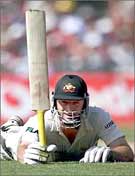
Jan 6th 2004: After being away from home for a year and a half, I was enjoying time with my family. I was also happy to be witnessing a great cricketing battle between India and Australia. India were 1-1 against the invincible Aussies and were totally dominating the third test with Sachin scoring a masterly 220 on the aussie turf !! But for that day, I wore a baggy green when the Australian captain walked down to the pitch for the last time in his cricketing career with the mighty aussies once again depending on him to take them out of trouble.
This blog is dedicated to a sporting hero from whom I have tried to learn so much about attitude, grit and a never-give-up attitude. Yes, I am talking about the "Tugga", and one of my all time favorite cricketers Stephen Rodger Waugh.
When the going gets tough, the tough get going. There is no better example to this in Cricket than him, Steve Waugh saved that match for Australia with a gritty 80 and walked off the Sydney cricket ground amidst thunderous ovations. Grit and determination were his defining virtues once again.
Who could forget his 200 against the West Indies at Sabina Park in 1995, his twin centuries against England at Old Trafford in 1997, or his daring 120 against South Africa in a must-win match at the 1999 World Cup. This uncanny ability to fight his way out of trouble that has seen Steve making a name as one of the greatest batsmen of all time. A man who would put his best foot forward during times of adversity - a tremendous competitor.
Steve Waugh may not have had the talent of The God or The Don, the technique of The Wall or the attacking flair of The Prince. Infact he was considered the lesser talented than his twin, Mark. but I would rate him always a notch above the rest simply because of all that he brought to the game in terms of attitude, grit and more importantly, leadership.
Though many critics attribute the team's success to Warney and Mcgrath, It was beyond doubt that there was a noticeable change in strategy and style and the whole approach towards cricket under Steve. He led the Aussies to a World Cup triumph in 1999 and is still the most succesful test captain with 41 victories from 57 tests. It was under him, that a good team transformed into a great team.
That he is an Indophile and is committed to social causes is a folklore now, Steve Waugh was named Australian of the Year in 2004.
Coincidentally, his name Stephen in greek means 'Crown'!, but ironically, he is a perfect example of an average player achieving beyond potential.
What makes one a great leader? That will be in another post.
Talking about leaders, I am happy that Mr.Jairaj whom I wrote about in an earlier post is back as BMP chief in Bangalore.
Current Music:
Sultans of Swing - Dire Straits
Monday, November 15, 2004
Full Circle
The election fever is over and the results were no different than what I had predicted in my last blog.
Thanks to my BIL(Bro-In-Law), I have been meeting a few ppl in DC.
I have been fortunate to meet one of Bangalore's most admired IAS(civil services) officer Mr. Jairaj on previous two weekends. He was Bangalore city commisioner under SM Krishna and was phenomenally succesful in bringing out sweeping changes into the city. He is currently on an assignment in the World Bank here in DC.
Mr. Jairaj is an amazingly simple and humble person. He is a Delhi school of economics graduate and with degrees from Princeton and Harvard!! The humor he brings during his conversations is something to be experienced. As he spoke about his experiences as an IAS officer and the differences that he could bring about into the system I was often getting nostalgic. As a seventh grade student and even later during my high school, I was extremely passionate about clearing my civil service exams. I had collected nearly 60-70 interviews with IAS toppers.. I used to religiously read every issue of CSR. By 8th standard I had decided what my main subjects and optional subjects were going to be when I take up the exam!! But somehow the zest didnt last long enough for various reasons. I started getting attracted to the IITs(which I never made) when my sisters got in there and then ofcourse the IT boom took off and took most of us! Looking back now, I regret many a times that getting into traditional engineering and then IT shouldnt have been my first choice at all, It was rather a blind decision.
Today we had been to a Diwali gathering. I met two MBAs, one from Wharton and the other from Harvard. Both are IAS officers working at World Bank. One of them has worked under Naidu and the other has a Masters from IISc before getting into civil services. What I found as a paradox was, interacting with such people gives you confidence on one hand for a few reasons and on the other hand it also serves as a reality check.
A few years back I used to regularly listen to music for around 20 hrs per day. It had reached a limit. Then it had drastically reduced over the last couple of years. I am getting back to the groove. I have been having short bursts of intense listening :). As I am writing this I am listening to a classical ghazal from Mehdi Hassan, the rendering is supreme..
The place where we had been to on diwali, There was a guy around my age. I think his name was Uday. He has been brought to US from India to be of help with household work. All of us probably must have had an eye contact with him maybe once or twice during the entire evening. He would have never been to colleges, never driven around in cars ... and he will probably never be able to rise in his stature during his entire life...... and he is only one among several million others back home.
Current Music:
Kesariya Balam Padharo Maro Desh
Mehdi Hassan
Thanks to my BIL(Bro-In-Law), I have been meeting a few ppl in DC.
I have been fortunate to meet one of Bangalore's most admired IAS(civil services) officer Mr. Jairaj on previous two weekends. He was Bangalore city commisioner under SM Krishna and was phenomenally succesful in bringing out sweeping changes into the city. He is currently on an assignment in the World Bank here in DC.
Mr. Jairaj is an amazingly simple and humble person. He is a Delhi school of economics graduate and with degrees from Princeton and Harvard!! The humor he brings during his conversations is something to be experienced. As he spoke about his experiences as an IAS officer and the differences that he could bring about into the system I was often getting nostalgic. As a seventh grade student and even later during my high school, I was extremely passionate about clearing my civil service exams. I had collected nearly 60-70 interviews with IAS toppers.. I used to religiously read every issue of CSR. By 8th standard I had decided what my main subjects and optional subjects were going to be when I take up the exam!! But somehow the zest didnt last long enough for various reasons. I started getting attracted to the IITs(which I never made) when my sisters got in there and then ofcourse the IT boom took off and took most of us! Looking back now, I regret many a times that getting into traditional engineering and then IT shouldnt have been my first choice at all, It was rather a blind decision.
Today we had been to a Diwali gathering. I met two MBAs, one from Wharton and the other from Harvard. Both are IAS officers working at World Bank. One of them has worked under Naidu and the other has a Masters from IISc before getting into civil services. What I found as a paradox was, interacting with such people gives you confidence on one hand for a few reasons and on the other hand it also serves as a reality check.
A few years back I used to regularly listen to music for around 20 hrs per day. It had reached a limit. Then it had drastically reduced over the last couple of years. I am getting back to the groove. I have been having short bursts of intense listening :). As I am writing this I am listening to a classical ghazal from Mehdi Hassan, the rendering is supreme..
The place where we had been to on diwali, There was a guy around my age. I think his name was Uday. He has been brought to US from India to be of help with household work. All of us probably must have had an eye contact with him maybe once or twice during the entire evening. He would have never been to colleges, never driven around in cars ... and he will probably never be able to rise in his stature during his entire life...... and he is only one among several million others back home.
Current Music:
Kesariya Balam Padharo Maro Desh
Mehdi Hassan
Subscribe to:
Posts (Atom)

